



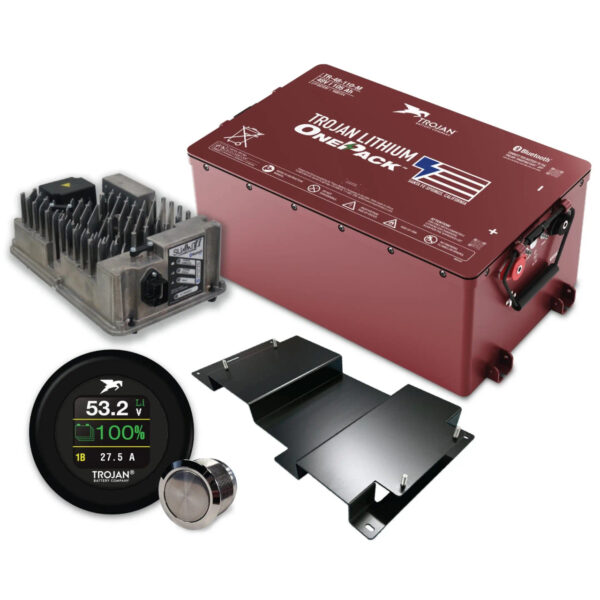
A lithium conversion replaces the six or eight heavy lead-acid batteries under your seat with one lithium iron phosphate (LiFePO4) battery, a lithium charger and a few supporting parts. Done right, it cuts hundreds of pounds, ends battery watering and gives you power that stays strong until the battery is nearly empty. This guide walks through the whole job: why people convert, every install step, what to know for your make and model, how to size the battery, what it costs and the mistakes we see most often.
Every number here comes from the battery makers' published data. Where a detail depends on your cart, we say so, and you can always send us your cart's make, model, year and serial number before you order.
Why convert to lithium?
Weight
Interstate Batteries' own comparison puts a 48V pack of eight 6V flooded batteries at about 495 lbs (530 lbs for AGM), against about 95 lbs for a single 48V 100Ah lithium battery. Bedrock's 48V 105Ah Compact weighs 95.9 lbs and its 48V 150Ah weighs 133.4 lbs. That's less load on the motor, brakes, springs, tires and turf.
Range and usable capacity
Interstate rates lead-acid at about 50% usable capacity, because discharging it deeper shortens its life, and lithium at 100%. In the same comparison it lists up to 30 miles per charge for its lead-acid packs and up to 50 miles for its lithium battery. Lithium also holds its voltage until it's nearly empty, so the cart doesn't get sluggish at the end of the day the way a tired lead-acid pack does.
Lifespan
Interstate lists 400-500 cycles and a 4-5 year life for flooded lead-acid, 500+ cycles and 5+ years for AGM, and more than 2,500 cycles and 10+ years for its LiFePO4 battery. Bedrock rates its batteries for up to 6,000 cycles and backs its conversion kits with a 10-year transferable warranty. Other lithium warranties we carry run from 8 to 12 years (ECO Battery states a limited lifetime warranty), against a 6- or 12-month free-replacement warranty on Interstate's lead-acid golf cart batteries.
Cost over time
A lithium kit costs more on day one than a set of lead-acid batteries. The comparison changes when you count how many times you'd replace the lead-acid set over the life of one lithium battery, plus the water, the terminal cleaning and the charger you'd eventually replace anyway. See the cost comparison below for current prices from our store.
Maintenance
Flooded batteries need distilled water, terminal cleaning and equalizing. Sealed lithium needs none of that; Bedrock's batteries are IP67-rated and report their state to a Bluetooth app.
What's in a conversion kit
Kits differ by brand, so always check the "What's included" list on the product page. As examples from our listings:
- Bedrock Battery kits: the battery, a waterproof 15A lithium charger (with self-tapping mounting screws), an AC charge-port plug with a cart-specific or universal adaptor, a round state-of-charge (SOC) meter with a 115 in. cable, a cart-specific bracket where one exists (otherwise the standard bracket), and cart-specific ring terminals and bolts. The 12V converter is not included, and Bedrock lists one as required for most carts.
- BOLT Energy kits: the battery, a CAN-communicating lithium charger (18A on most kits, 15A on the Onward kit), an LCD SOC meter, a charge receptacle for your cart, a remote on/off (wake-up) button, brackets and hardware, and printed instructions.
- Allied Lithium Commercial packages: the battery with a Bluetooth BMS, mounting brackets (for most batteries), 4-gauge cables, hardware, a waterproof lithium charger and a charging harness. The RS model adds a remote power button and a relay BMS with an internal solenoid. The SOC meter (Allied Comm Port SOC Meter) and a 12V converter are sold separately.
Some go further: Lithium Rhino and EPOCH kits include a 12V DC-DC converter. Compare what's in the box, not just the price.
Step-by-step: how a conversion goes
This is an overview of the order of work, not a replacement for the instructions that ship with your kit. Your battery maker's manual always wins, and following it is usually a warranty condition. The install videos further down show the same steps on real carts.
1. Safety first and disconnect
Park on level ground, set the brake, turn the key off and take it out. If your cart has a Tow/Run switch, set it to Tow. Wear safety glasses and gloves, take off rings and watches, and use insulated tools: a wrench that bridges a terminal and the frame can arc and weld. Before you touch a cable, take clear photos of how the pack is wired, including where any accessories connect. Then disconnect the main negative cable first, followed by the main positive.
2. Remove the lead-acid batteries and hold-downs
Remove the jumper cables between batteries, then the hold-down bars or brackets. Lead-acid golf cart batteries are heavy and full of acid, so lift them straight up with a battery strap and a helper, keep them upright and set them on a surface that won't mind a drip. Lead-acid batteries are recyclable and must not go in the trash. [ROD TO CONFIRM: core charge and old-battery recycling or drop-off details]
3. Clean the tray and check bracket fit
With the tray empty, clean off acid residue (a baking soda and water mix neutralizes it), rinse, dry, and check the tray and frame for corrosion or cracks. A lithium battery is a single large block, so it needs a bracket or hold-down sized for it: some carts get a cart-specific bracket, others the maker's standard bracket. Fitment details matter here (see the make-by-make notes). Bedrock, for example, sells a tall bracket (BB-BKT-0051) for its 48V 150Ah and 72V 105Ah batteries in the EZGO TXT.
4. Mount the battery
Set the battery in the tray in the orientation shown in your manual, so the terminals face the right way and the cables reach without strain. Fit the bracket and tighten the hardware so the battery can't shift under braking or over bumps.
5. Connect the main cables
Connect the main positive and negative cables to the battery with the ring terminals supplied. The series jumpers from the old pack are no longer needed. Tighten to the torque in the manual, because a loose terminal heats up under load. Use the cables that came with your kit or ones of the same gauge or heavier: Allied supplies 4-gauge cables, and Bedrock also sells heavy-duty 2-gauge cables (BB-HDC-0220). Some systems also need a battery disconnect: Allied's warranty is void if its Drop-in-Ready batteries are installed without its 500A battery disconnect switch.
6. Hook up the BMS and the state-of-charge meter
Every lithium battery we sell has a battery management system that protects the cells and reports their state. The original "fuel gauge" on a lead-acid cart reads pack voltage, and because lithium holds a nearly flat voltage until it's almost empty, that gauge won't read correctly. Instead, connect the SOC meter from your kit (Bedrock's round meter, BOLT's LCD meter) and mount it where you can see it. Bedrock sells a dash bracket for its meter (BB-MET-0033). Connect any communication lead and wake-up button, and pair the Bluetooth app if there is one.
7. Swap the charger: never use the old lead-acid charger
Lithium must be charged with a lithium charger matched to its voltage. Lead-acid chargers use charge stages built for lead-acid; the wrong charger can damage a lithium battery or void its warranty. Install the charger and charge port from your kit, disconnect or remove the old charger, and label it so nobody plugs it back in. Buying a battery without a kit? Choose its listed charger, such as the Bedrock 48V charger or Allied 48V 15A charger, plus a charging harness if needed. Bedrock lists a charging range of 32-131°F for its batteries, and LiFePO4 should not be charged below freezing unless the battery is heated or has low-temperature protection. Bedrock offers a heated version on request.
8. Add a 12V reducer for accessories
On many lead-acid carts, lights, horns, radios and USB ports are wired to one or two batteries in the pack. A single 48V lithium battery has no 12V point to tap, and tapping part of a pack unbalances it anyway. The fix is a 12V converter (also called a reducer or step-down converter) wired from the main battery to your accessories:
- Bedrock 12V converter for 36V carts and Bedrock 12V converter for 48V / 72V carts (Bedrock rates its 48V converter at up to 25A).
- Allied 36V/48V to 12V converter and Allied 72V to 12V converter, both 30A max, waterproof and die-cast aluminum.
- A fuse block if you're running several accessories, so each circuit has its own fuse.
Add up the current your accessories draw and make sure it's within the converter's rating.
9. Test before the first ride
Recheck every connection and the bracket. Switch the battery on (press the wake-up button if your kit has one), set Tow/Run back to Run and confirm the SOC meter and app show the battery. Test forward and reverse at low speed in an open area, then try a gentle hill. Plug in the charger and confirm it starts charging, and follow the manufacturer's instructions for the first full charge. Keep the paperwork for warranty claims.
Install videos from the battery makers
These are the brands' own install guides. They load only when you press play.
Conversion notes by make and model
Start with your cart's voltage: count the batteries under the seat and multiply by the number on each one (six 6V = 36V; eight 6V, six 8V or four 12V = 48V). The Fitment Guide lists every battery we sell by make, model and year. A few points apply to every cart:
- Amp draw: the battery's continuous discharge rating should cover what your motor controller can pull. Bedrock's BMS ratings are 200A continuous (500A for 3 seconds) on its 36V 105Ah, 250A continuous (600A peak) on its 48V 105Ah, and 300A continuous (600A peak) on its 48V 150Ah and 72V 105Ah. BOLT Energy lists 185A continuous on its 48V 60Ah Fleet battery and 250A on its 105Ah and 160Ah packs. If your cart has an upgraded high-amp controller, tell us its rating before you order. For high-performance builds, consider heavy-duty 2-gauge cables and a heavy-duty solenoid such as the Curtis Albright SW180 (48V, 400+ amp).
- Speed settings: many carts limit top speed in the controller's programming. A lithium battery doesn't change that setting. Changing a speed setting is separate controller work, and it raises amp draw. [ROD TO CONFIRM: whether we program controller speed settings]
- Factory lithium vs lead-acid carts: a "conversion" kit replaces a lead-acid pack. Carts that left the factory with lithium (for example the EZGO Liberty and the Evolution D5 and D-MAX) need a "replacement" pack built to talk to that cart.
Club Car: DS, Precedent, Onward, Tempo
DS. DS carts were built in both 36V and 48V versions, so count your batteries first. We stock 36V DS kits from Bedrock, BOLT, ECO, EPOCH, Lithium Rhino and MODZ, and 48V DS kits from Bedrock (48V 65Ah and 48V 105Ah Compact with the A-frame bracket), BOLT, ECO and EPOCH. See the Bedrock 48V 105Ah Compact DS kit.
Precedent. The Precedent is a 48V cart, and the model year matters: Bedrock sells separate kits for 2004-2008 and 2009+ Precedents. Our Precedent conversion kits include Bedrock's 48V 65Ah, 105Ah Compact and 150Ah, plus kits from nine other brands.
Onboard computer (OBC). Some older Club Car carts have an onboard computer that works with the original charger. With a lithium charger, these carts may need an OBC bypass if your kit's maker calls for it. Ask us if your Club Car has one.
Onward and Tempo. These are 48V carts that Club Car sold with lead-acid or factory lithium. For a lead-acid Onward or Tempo, Bedrock's Precedent 2009+ kits are listed for both (for example the 48V 105Ah Compact kit for Precedent '09+ / Onward / Tempo), alongside Onward and Tempo kits from BOLT, ECO, EPOCH and Vatrer. If your Onward or Tempo already has factory lithium, contact us for a replacement pack.
72V. Bedrock lists a 72V 105Ah kit for the Precedent 2009+, Onward and Tempo. Treat 72V as a performance build: the motor, controller and solenoid must be rated for 72V.
EZGO: TXT, RXV, Valor, Liberty
TXT. The TXT came as a 36V cart and as the 48V TXT48. We carry 36V TXT kits (Bedrock 36V 105Ah, BOLT, ECO, EPOCH, Lithium Rhino, MODZ), 48V TXT kits (Bedrock 48V 65Ah, 105Ah Slim and 150Ah, BOLT, EPOCH, Vatrer) and a 72V TXT kit from Bedrock. The 48V 150Ah and 72V batteries are taller and use Bedrock's tall TXT bracket.
RXV. The RXV is a 48V cart. Bedrock's kits are split by battery tray, metal or plastic, so check yours before you order. Our RXV conversion kits come from ten brands. For an RXV that came with factory lithium, see the RXV replacement packs from ECO Battery (48V 105Ah and 160Ah).
Valor. We don't have a Valor-specific listing yet. Send us your cart's details and we'll tell you what fits.
Liberty. The Liberty is a factory-lithium cart, so it takes a replacement pack rather than a conversion kit. We stock ECO Battery's 48V 105Ah Liberty replacement battery.
Yamaha: G29 Drive and Drive2
Drive (G29). A 48V cart. Bedrock sells its 48V 105Ah Compact kit in two versions, for 2007-2010 Drives and for 2011+ Drives and the Drive2, and its 48V 65Ah kit fits the Drive and 48V G-series. See all Drive (G29) kits, including BOLT, ECO, EPOCH and Vatrer.
Drive2. Also 48V. Bedrock's Drive / Drive2 kits come in 48V 105Ah Compact, 48V 150Ah and 72V 105Ah, and we carry Drive2 kits from BOLT, ECO, EPOCH and Vatrer too. For harnesses, Allied makes a 48V Yamaha charging harness and a Yamaha 110V onboard charging plug.
Older G-series. G1-G16 carts are 36V and G19-G22 carts are 48V; see the G-series kits.
ICON, Evolution and other makes
ICON. We carry 48V ICON kits for the i20 / i40 and i60 / i80 from BOLT Energy (105Ah) and ECO Battery (60Ah, 105Ah and 160Ah), plus Bedrock's ICON / Advanced EV kits in 48V 105Ah Slim, 48V 150Ah and 72V 105Ah.
Evolution. The Evolution Classic takes a conversion kit (BOLT 48V 105Ah Slim). The D5 and D-MAX came with factory lithium and take replacement packs from ECO Battery and BOLT Energy; BOLT's packs talk to the cart through an included CAN adapter. See Evolution D5 and D-MAX batteries.
Denago, Star EV and Advanced EV. ECO Battery makes replacement packs for the Denago Rover and Nomad. Bedrock has kits for Star EV and Advanced EV.
Anything else. Bedrock's universal kits ship with a standard bracket and generic hardware, and Allied's Commercial packages cover 36V, 48V and 72V carts and UTVs. Both need a fitment check first, so contact us before ordering.
Choosing 36V, 48V or 72V
A conversion normally keeps the cart's original voltage, because the motor, controller, solenoid and charger port are all built for it.
- 36V carts (older Club Car DS, EZGO TXT and Yamaha G1-G16) take a 36V lithium battery. Moving a 36V cart to 48V means changing the controller, solenoid and often the motor, so it's a rebuild, not a battery swap.
- 48V is the most common system and has the widest choice: see all 48V lithium batteries.
- 72V (72V batteries) is for carts built or upgraded for it. Bedrock's 72V 105Ah stores 7.73 kWh, about the same energy as its 48V 150Ah (7.68 kWh). More voltage only helps if the rest of the drivetrain is rated for it.
Our 36V vs 48V guide goes deeper.
Sizing amp-hours for your range
Amp-hours (Ah) times nominal voltage gives the energy in the battery: Bedrock's 48V 105Ah stores 5.38 kWh and its 48V 150Ah 7.68 kWh. More energy means more miles, but also more weight and cost. Bedrock publishes these range estimates by cart size:
| Bedrock battery | Energy | Weight | 2-seat | 4-seat | 6-seat |
|---|---|---|---|---|---|
| 36V 105Ah | 4.032 kWh | 80.5 lbs | 20-35 mi | 15-25 mi | N/A |
| 48V 65Ah | 3.072 kWh | 62.8 lbs | 15-25 mi | 10-20 mi | Not recommended |
| 48V 105Ah (Compact / Slim) | 5.38 kWh | 95.9 / 98.1 lbs | 30-45 mi | 20-35 mi | 20-30 mi |
| 48V 150Ah | 7.68 kWh | 133.4 lbs | 50-70 mi | 40-60 mi | 30-50 mi |
| 72V 105Ah | 7.73 kWh | 141.1 lbs | 40-60 mi | 35-50 mi | 35-45 mi |
Range estimates and weights are published by Bedrock Battery. Bedrock says actual range varies with terrain, load, speed and cart setup.
As a starting point:
- 60-65Ah suits light use: a 2-seater on flat ground, neighborhood trips, a round or two between charges. Bedrock doesn't recommend its 48V 65Ah for 6-seaters.
- 100-105Ah is the all-round choice for most 2- and 4-seat carts.
- 150-168Ah (and ECO's 160Ah) is for lifted carts, big tires, 4- and 6-seaters, hills, street use, long days or a lot of accessories.
The range and amp-hours guide explains how passengers, lift kits, tires, hills and speed eat into range.
Tools, time and difficulty
Most kits are built for a DIY install with ordinary hand tools. You'll want:
- Safety glasses, chemical-resistant gloves and insulated tools.
- A socket set and wrenches for the battery terminals and hold-downs, and a torque wrench for the terminals.
- A drill or driver for mounting the charger and SOC meter (Bedrock's charger mounts with self-tapping screws).
- Wire strippers, a crimper and heat-shrink for the 12V converter and accessory wiring.
- A battery strap, a helper and a hand truck for the old batteries.
- Baking soda and water for the tray, and a multimeter.
Difficulty: moderate. If you can follow a wiring diagram and work carefully around high-current connections, you can do it. The hard parts are lifting out the old batteries and wiring the 12V accessories. Time: the brands' install videos above show the full job on each cart; give yourself an unhurried morning or afternoon, plus extra time if you're rewiring lights or a radio.
DIY or professional install?
DIY saves money and the kits are designed for it. A professional install makes sense if your cart has aftermarket upgrades (a high-amp controller, a lift kit with extra accessories), if you'd rather not handle several hundred pounds of lead-acid batteries, or if you want someone else to deal with the old batteries. Every battery we sell can be shipped to you or delivered locally (see Shipping & Local Delivery). [ROD TO CONFIRM: whether we offer installation with local delivery, the install area and the fee]
Common mistakes to avoid
- Using the old lead-acid charger. Lithium needs its matched lithium charger. Remove or label the old one.
- Ordering by make alone. Year and tray type matter (Precedent 2004-2008 vs 2009+, RXV metal vs plastic tray, Drive 2007-2010 vs 2011+). Check the Fitment Guide or ask us.
- Skipping the 12V converter. Lights or a radio tapped off the old pack have nowhere to connect. Bedrock lists a converter as required for most carts.
- Changing voltage without changing the drivetrain. A 72V battery in a stock 48V cart isn't an upgrade, it's a mismatch.
- Undersizing the battery. Size for how you really use the cart.
- Loose or undersized cables. Torque the terminals.
- Trusting the old fuel gauge. Use the lithium SOC meter or the app.
- Charging below freezing without a heated or protected battery.
- Skipping required parts. Some warranties depend on them, such as Allied's disconnect switch for Drop-in-Ready installs.
- Throwing away lead-acid batteries. Recycle them.
Cost comparison: lead-acid vs lithium
Current prices from our store for a 48V cart, with weights, cycle ratings and warranties as the makers publish them:
| Option (48V cart) | Price today | Weight | Rated cycles | Warranty | Upkeep | Battery cost over 10 years** |
|---|---|---|---|---|---|---|
| Interstate GC2-HCL 6V flooded, set of 8 | $1,599.60 | 495 lbs* | 400-500* | 12-month free replacement | Watering, cleaning, equalizing | $3,199.20 to $4,798.80 (2-3 sets) |
| Interstate GC8-HCL 8V flooded, set of 6 | $1,409.70 | Not published | 400-500* | 12-month free replacement | Watering, cleaning, equalizing | $2,819.40 to $4,229.10 (2-3 sets) |
| Interstate GC2-HD-AGM 6V AGM, set of 8 | $3,519.60 | 530 lbs* | 500+* | 12-month free replacement | Sealed | $7,039.20 (2 sets) |
| Bedrock 48V 65Ah kit (charger included) | $1,549.00 | 62.8 lbs | Up to 6,000 | 10-year transferable | None | $1,549.00 (1 battery) |
| Bedrock 48V 105Ah Compact kit (charger included) | $2,099.00 | 95.9 lbs | Up to 6,000 | 10-year transferable | None | $2,099.00 (1 battery) |
| Bedrock 48V 150Ah kit (charger included) | $2,749.00 | 133.4 lbs | Up to 6,000 | 10-year transferable | None | $2,749.00 (1 battery) |
* From Interstate's published 48V comparison (eight 6V batteries). Lithium figures are Bedrock's. Bedrock kits include a charger but not the 12V converter; lead-acid sets include neither. Prices are current store prices. ** Uses Interstate's published lifespans (flooded 4-5 years, AGM 5+, LiFePO4 10+) at today's prices, without chargers, water or labor. An illustration, not a quote.
Conversion FAQs
Can I convert my golf cart to lithium myself?
Yes. Most kits are designed for a DIY install with hand tools, and they come with instructions; the brands also publish install videos. Plan for a few hours, a helper to lift out the lead-acid batteries, and follow the manufacturer's manual, which is usually a warranty condition.
Do I need a new charger when I switch to lithium?
Yes. A lithium battery must be charged with a lithium charger matched to its voltage, never the old lead-acid charger. Most conversion kits we sell include one (Bedrock kits include a waterproof 15A lithium charger, for example).
Do I need a 12V converter?
If your cart has lights, a horn, a radio or USB ports that were wired to part of the old battery pack, yes. Bedrock lists a 12V converter as required for most conversions and it isn't included in its kits. We stock Bedrock and Allied converters.
How far will a lithium golf cart go on a charge?
It depends on capacity and how the cart is used. Bedrock estimates 30-45 miles for its 48V 105Ah in a 2-seat cart and 50-70 miles for its 48V 150Ah, and says actual range varies with terrain, load, speed and cart setup.
Will lithium make my golf cart faster?
Lithium holds its voltage better as it discharges, so the cart feels strong to the end of the charge, but top speed is set by the motor and the controller's programming. Changing speed is separate controller work.
Can I put a 72V battery in my 48V cart?
Only if the motor, controller and solenoid are rated for 72V. On a stock 48V cart, stay with a 48V battery.
What do I do with my old lead-acid batteries?
Recycle them. Lead-acid batteries are recyclable and must not go in household trash. Ask us about recycling when you order.
Next steps
- Find your cart in the Fitment Guide, or browse Club Car, EZGO and Yamaha batteries.
- Compare universal conversion kits, lithium chargers and 12V converters and accessories.
- Read more: Lead-acid vs lithium, Converting to lithium, Charger guide, How to choose a battery, Battery maintenance and How long batteries last.
- For powersports and boats: Powersports batteries and Trolling motor batteries.
Pay over time
Split eligible orders into 4 payments with Klarna or Afterpay, or pay monthly with Affirm. Plans usually start around $50. You confirm the terms at checkout.