




Sacramento, Modesto, and Bakersfield summers are a heat and dust problem. Charge when the garage is not heat-soaked.
The answer for a cart in California’s Central Valley
Tule fog and a damp winter are a corrosion season, not a voltage change.
Agricultural dust on a pack should be wiped off. It holds moisture against the case.
Wherever the cart is parked, we ship the battery. Local delivery is only the area named on the shipping page. This climate note is not a store address and not a driver assigned to that region.
Hold that answer while you read the shop notes under it. The notes are the same rules we use on every cart. The answer above is the part that is specific to a cart in California’s Central Valley.
Resting voltage, not a guess from the seat
A resting check is not a load test, and it is still the first number worth writing down. Charge a lead-acid pack fully, unplug the charger, and wait a few hours. A healthy flooded 6-volt battery rests near 6.3 volts. A healthy 8-volt rests near 8.4. A healthy 12-volt deep-cycle rests near 12.6. Measure the pack from the main positive to the main negative too. A 36-volt string of six 6-volt batteries rests near 38 volts. A 48-volt lead string rests near 50 volts.
A battery that sits a full volt under its neighbors is the weak one. Replace the set anyway. One new battery in a tired string does the work for the old ones. A lithium pack does not use these lead-acid resting numbers. Read the meter that came with the kit, and do not call the pack dead because it is not sitting at 50 volts.
The 12-volt converter is a separate part
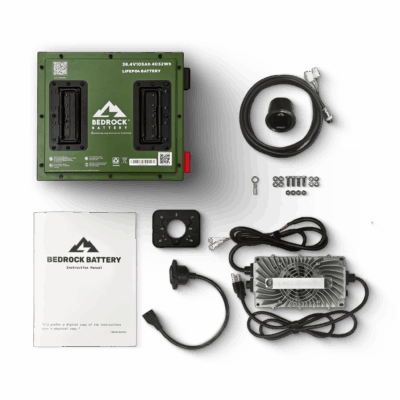
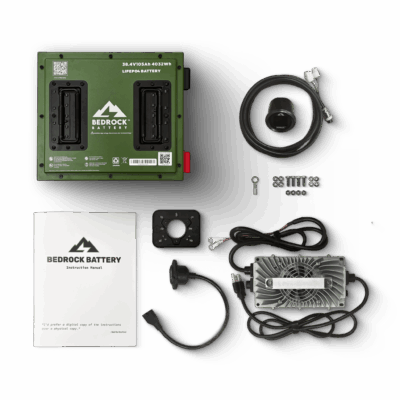
A lead-acid pack often fed 12-volt lights and accessories from part of the string. A single lithium battery does not have that tap. Most carts need a 12-volt converter after the swap, or the lights, horn, and controller accessories fail. Bedrock kits do not include the converter. Bedrock lists one as required for most carts.
A 36-volt lithium cart uses converter SKU BB-CVT-0936. A 48-volt or 72-volt lithium cart uses SKU BB-CVT-0948. Do not add a converter to an order that is already the converter. Do not skip the converter on a 48-volt kit because the cart ‘seems to run’ on a test drive around the block. The motor can run while the 12-volt system is unpowered or, worse, fed the wrong voltage.
BOLT’s voltages are nominal lithium voltages
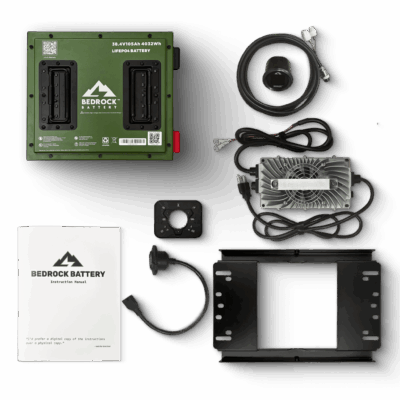
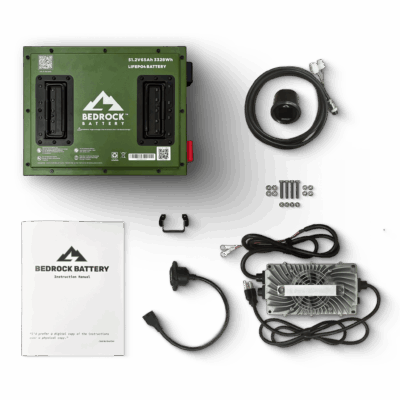
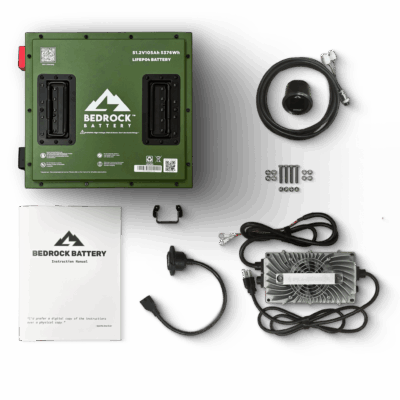
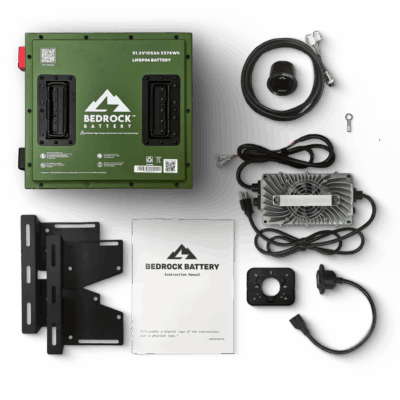
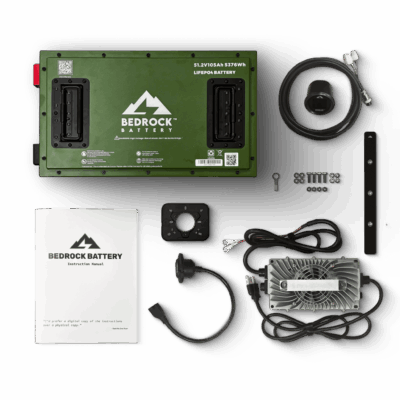
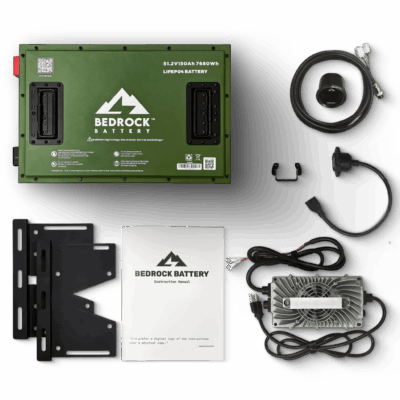
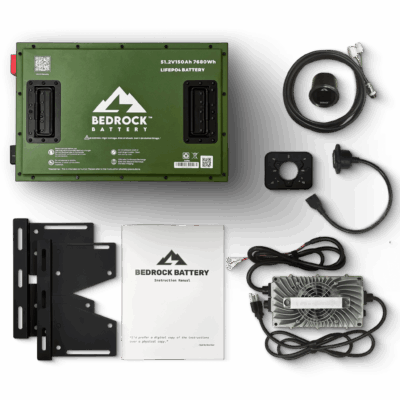
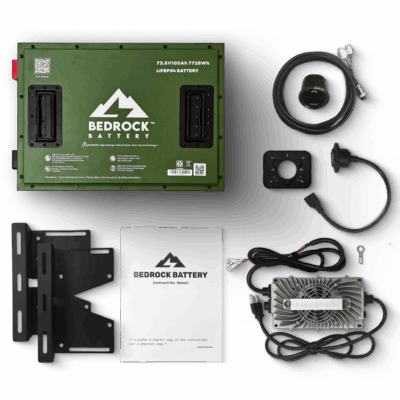
BOLT lists 38.4 volts for 36-volt carts, 51.2 volts for 48-volt carts, and 73.6 volts for 72-volt carts. A 38.4-volt battery is not a weak 48-volt battery. Capacities in the line run from 60Ah to 160Ah, including a compact 51.2-volt 105Ah Mini. BOLT’s warranty is 12 years and transferable.
Kits name specific carts, including Denago on some listings. If your cart is not named, do not borrow a Club Car bracket and hope. BOLT is based in Largo, Florida, in the Nivel family. That fact does not create a storefront for us in Largo.
Shipping, and what a city page means
We ship golf cart batteries. We do not publish a storefront street address. Lithium golf cart kits from every brand we sell ship free to the lower 48 by curbside truck freight. Parts, chargers and small batteries ship free on orders of $150 or more, or $14.95 below that. Interstate lead-acid batteries ship on a freight quote: we call you with the price before we charge shipping.
Local delivery exists only for the area named on the shipping page. A state page or a town page means that community is one we write about and ship to. It is not a claim that a driver covers that town. If the shipping page does not name your street, the order ships.
Salt air and corrosion
Coastal carts, island carts, and carts parked near a bay grow corrosion on posts and lugs. White or green crust raises resistance. The cart feels weak. The charger works harder. Disconnect the main negative first, neutralize the crust with a baking-soda paste, brush the post and the lug, dry everything, and reassemble the lug flat and tight. A thin film of dielectric grease after it is tight slows the next round.
Salt is not a reason to leave caps off a flooded battery. It is a reason to keep the tops of the cases clean so a film of moisture and acid does not leak current between posts. If the copper strands under the insulation are green, replace the cable. A new battery on a rotten cable will not fix the cart.
S, UT, and UTL terminals
Lead-acid golf batteries are sold with more than one post. An S post, a UT post, and a UTL post do not accept the same lug the same way. Look at the cable end you already have before you pick the dropdown on the product page. Interstate listings in this shop let you choose the terminal on most models.
Bending a lug to reach the wrong post guarantees a loose connection. If the cables are burned, replace the cables and then match the new lugs to the new posts. Do not pick a terminal style because it is the first option in the list.
Partial charges: lithium yes, lead-acid no
Lithium iron phosphate is fine with a partial charge. Plug it in when you get home, unplug it when you leave, and do not wait for a once-a-week deep cycle. Lead-acid wants to be returned to a full charge after you drive. Leaving a flooded pack at half charge is how sulfate hardens.
That difference is why the charger has to match. A lead-acid charger’s finish voltage and equalize behavior are wrong for lithium. A lithium charger’s finish is wrong to interpret with a lead-acid hydrometer. Pick the chemistry, then the habit. Do not teach a household one rule for both.
A load test the household can actually do
Charge the cart, unplug it, rest it, and write down the pack voltage. Then have a helper press the pedal with the drive wheels safely off the ground, or drive up the usual hill while you watch a meter that is connected safely and out of the moving parts. A lead pack that falls apart under that load, while it looked fine at rest, is tired. A pack that holds voltage and still does not move is not a battery problem.
Do not do this with the meter leads in your hand while you drive. Clamp the meter where you can see it, or have the helper only on the pedal with the cart on stands. If you are not comfortable around the posts, stop and send photos. A short across a 48-volt string is a serious burn.
Parts and pages that match this
- Fitment guide
- Shop
- Lead-acid vs lithium
- Shipping
- Returns
- Warranty
- Contact
- Chargers
- Parts
- 48V/72V converter
- Shipping
- Florida
- Texas
- Arizona
The price for a cart in California’s Central Valley is the price on the product page, not a number in this article. Lithium golf cart kits from every brand we sell ship free to the lower 48 by curbside truck freight. Parts, chargers and small batteries ship free on orders of $150 or more, or $14.95 below that. Interstate lead-acid batteries ship on a freight quote: we call you with the price before we charge shipping. We ship a cart in California’s Central Valley. We do not list a storefront address. Local delivery is only the area named on the shipping page. A city page on this site is not a statement that a driver covers that city.