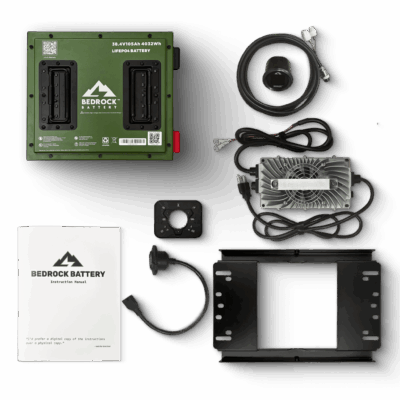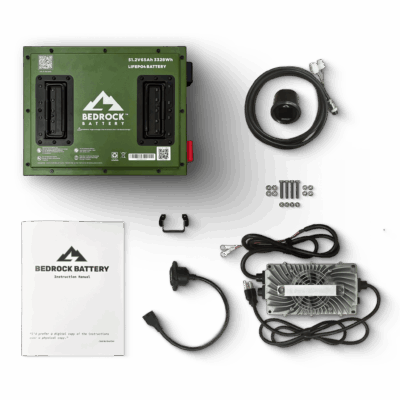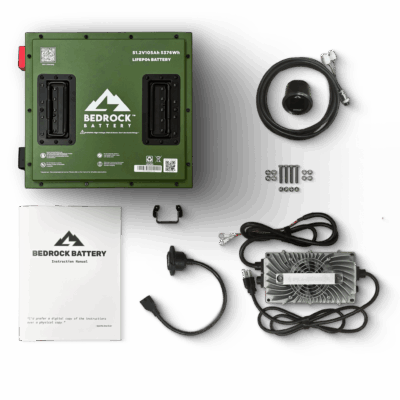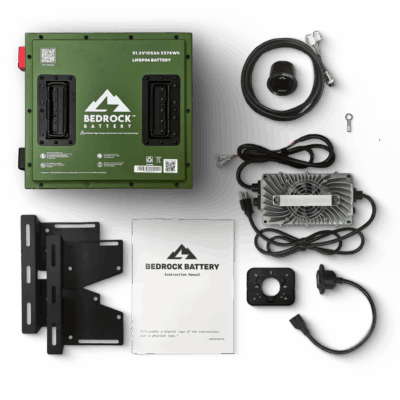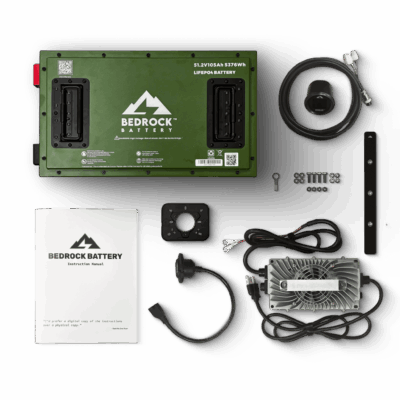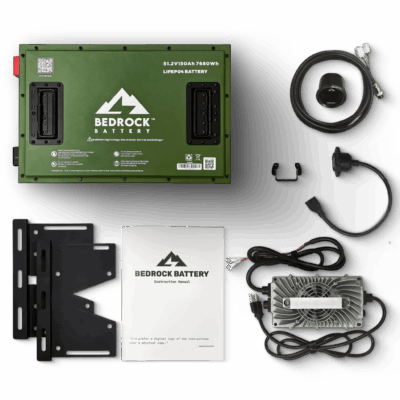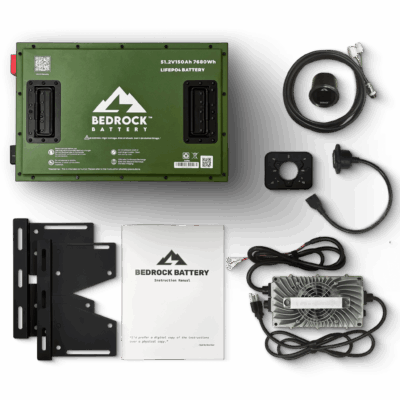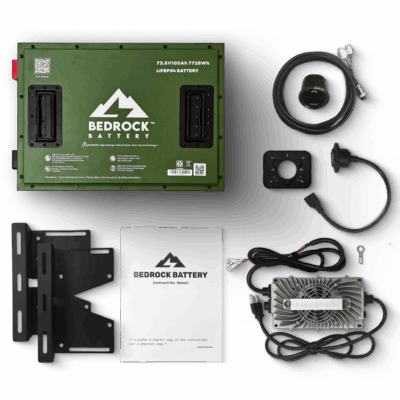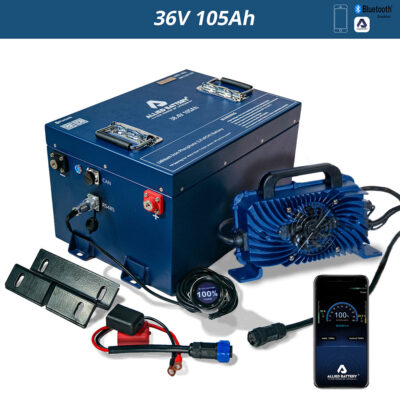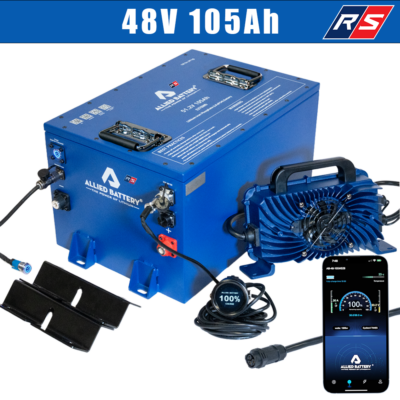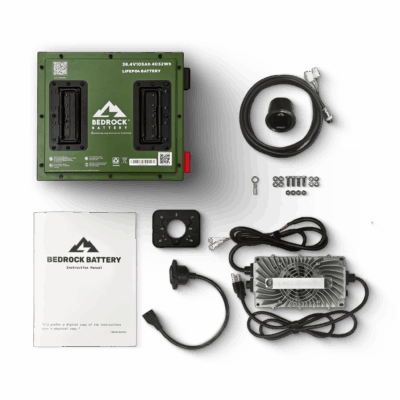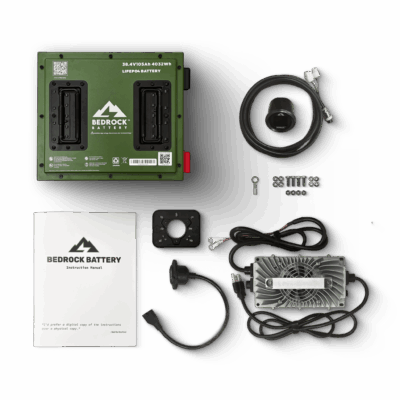





Both are 48-volt Bedrock packs. Voltage matches the same 48-volt cart. Amp-hours do not match each other.
The answer for a 48-volt Bedrock 105Ah pack versus a 150Ah pack
The 105Ah battery, compact or slim, holds 5.38 kWh and weighs 95.9 pounds on the 48-volt 105Ah size. It is rated up to 6,000 cycles. The 150Ah pack is the larger energy size in the same 48-volt family.
We will not invent a mile gap between them. Hills, seats, tires, and speed change distance. Use the range note on the product page if Bedrock prints one there.
A daily driver on a path system, a six-seat shuttle, or a lifted cart with big tires is the conversation where 150Ah earns its space and its money. A short flat loop often does not.
The tray still has to accept the case. A 150Ah pack that does not fit is not more range. It is the wrong shape.
Hold that answer while you read the shop notes under it. The notes are the same rules we use on every cart. The answer above is the part that is specific to a 48-volt Bedrock 105Ah pack versus a 150Ah pack.
Solenoids, clicks, and Curtis Albright
A click when you press the pedal means something tried to close the main contactor. It does not, by itself, mean the pack is done. If pack voltage holds under that load and the cart does not move, look at the solenoid, the key switch, the direction switch, and the safety switches. A solenoid that is welded shut can make the cart creep with the key on. A solenoid that clicks and drops out will not carry motor current.
Curtis Albright heavy-duty contactors are the upgrade when a high-amp controller and a lithium pack pull more current than the original solenoid was built for. A solenoid is a part. It does not add amp-hours. Do not buy one to cure a battery that sags from 50 volts to the 30s under load. That cart needs a pack, or a cable, not a bigger relay.
Equalizing is a flooded-battery procedure
An equalization charge is a controlled overcharge used on flooded lead-acid batteries to knock sulfate off the plates and even the cells out. You do it after the pack is full, with the caps in place, in a ventilated area, and you water after, not before. You do not equalize AGM batteries. You do not equalize a lithium pack. A lithium BMS is not asking for an equalize cycle from a lead-acid charger.
If one flooded battery is far below the others every month, equalization will not rebuild a dead cell. Replace the set. If you do not know whether your charger has an equalize mode, do not hold the button and hope. Read the charger manual for that one pack voltage.
Universal kits are a specific product
A universal lithium kit is the kit for a cart that does not have a named bracket in the line, or for a tray someone has already modified. It is not a cheaper version of a Precedent kit. Bedrock’s universal hardware is its own product. On some voltages the manufacturer’s photo of a named cart is the same file as the universal kit, because the hardware in that photo is the hardware they ship for both. Buy the title that matches the fitment guide, not the photo that looks familiar.
If your cart is a Denago, an Evolution, a Star EV, or an Advanced EV, start with a product whose page names that make. Fall back to universal only when the named list does not include your model. Do not fabricate a mount and then call it universal.
Outlets, cords, and tripped breakers
A golf cart charger is a continuous load. A thin extension cord, a coiled cord, or a tired GFCI outlet will heat or trip. Use a cord rated for the charger, keep it uncoiled, and plug into an outlet that can hold the load. A charger that resets every night is not ‘just sensitive.’ It is cooking a connection.
Do not plug a 48-volt charger into a pack of unknown voltage to ‘see what happens.’ Read the pack first. If the outlet is in a flood-prone garage, get the charger up off the floor. Salt air corrodes charge-port pins. A port that has to be wiggled to start the charge needs to be replaced, not lived with.
Resting voltage, not a guess from the seat
A resting check is not a load test, and it is still the first number worth writing down. Charge a lead-acid pack fully, unplug the charger, and wait a few hours. A healthy flooded 6-volt battery rests near 6.3 volts. A healthy 8-volt rests near 8.4. A healthy 12-volt deep-cycle rests near 12.6. Measure the pack from the main positive to the main negative too. A 36-volt string of six 6-volt batteries rests near 38 volts. A 48-volt lead string rests near 50 volts.
A battery that sits a full volt under its neighbors is the weak one. Replace the set anyway. One new battery in a tired string does the work for the old ones. A lithium pack does not use these lead-acid resting numbers. Read the meter that came with the kit, and do not call the pack dead because it is not sitting at 50 volts.
The 12-volt converter is a separate part
A lead-acid pack often fed 12-volt lights and accessories from part of the string. A single lithium battery does not have that tap. Most carts need a 12-volt converter after the swap, or the lights, horn, and controller accessories fail. Bedrock kits do not include the converter. Bedrock lists one as required for most carts.
A 36-volt lithium cart uses converter SKU BB-CVT-0936. A 48-volt or 72-volt lithium cart uses SKU BB-CVT-0948. Do not add a converter to an order that is already the converter. Do not skip the converter on a 48-volt kit because the cart ‘seems to run’ on a test drive around the block. The motor can run while the 12-volt system is unpowered or, worse, fed the wrong voltage.
BOLT’s voltages are nominal lithium voltages
BOLT lists 38.4 volts for 36-volt carts, 51.2 volts for 48-volt carts, and 73.6 volts for 72-volt carts. A 38.4-volt battery is not a weak 48-volt battery. Capacities in the line run from 60Ah to 160Ah, including a compact 51.2-volt 105Ah Mini. BOLT’s warranty is 12 years and transferable.
Kits name specific carts, including Denago on some listings. If your cart is not named, do not borrow a Club Car bracket and hope. BOLT is based in Largo, Florida, in the Nivel family. That fact does not create a storefront for us in Largo.
Parts and pages that match this
- Fitment guide
- Shop
- Lead-acid vs lithium
- Shipping
- Returns
- Warranty
- Contact
- Chargers
- Parts
- 48V/72V converter
- Bedrock Battery
- 48V lithium
The price for a 48-volt Bedrock 105Ah pack versus a 150Ah pack is the price on the product page, not a number in this article. Lithium golf cart kits from every brand we sell ship free to the lower 48 by curbside truck freight. Parts, chargers and small batteries ship free on orders of $150 or more, or $14.95 below that. Interstate lead-acid batteries ship on a freight quote: we call you with the price before we charge shipping. We ship a 48-volt Bedrock 105Ah pack versus a 150Ah pack. We do not list a storefront address. Local delivery is only the area named on the shipping page. A city page on this site is not a statement that a driver covers that city.