

The serial number helps when the year is worn off the body and the owner is guessing. It does not replace the battery count.
The answer for using a serial number for the year
Precedent and Drive year bands are why we ask. A 2008 and a 2009 Precedent are different lithium kits.
If you cannot find the plate, the tray photo and the battery labels still answer the voltage. Say that the year is unknown instead of inventing one.
Use the fitment guide with make, model, year, and voltage. If a model changed by year and you leave the year blank, the guide should say the bands instead of guessing a kit.
Hold that answer while you read the shop notes under it. The notes are the same rules we use on every cart. The answer above is the part that is specific to using a serial number for the year.
Interstate lead-acid sets
Interstate’s golf line in this shop is the GC2 6-volt family, the GC8 8-volt, and the GC12 12-volt, flooded and AGM, sold singly or as a complete set. You choose the terminal on most product pages. Free-replacement periods on the listings we carry are 12 months on several GC2, GC8, and GC12 models, 6 months on the GC2HC and GC2XHC, and 60 months of a 10-year limited warranty on the LIGC48V100 lithium battery.
The LIGC48V100 is lithium. Do not charge it with the flooded charger. The GC2, GC8, and GC12 batteries are lead-acid and carry the core charge. Interstate has recycled lead at scale for decades. The core you return is how the lead gets back into that loop.
Returns on batteries
Change-of-mind returns are 30 days with no restocking fee, and the customer pays that freight. If the item arrives damaged or we shipped the wrong one, tell us within 2 days. We pay that freight. Refunds go to the original payment method within 10 business days of inspection.
Installed, watered, or charged batteries are a final sale except for damage, the wrong item, or a warranty claim. That rule is why fitment happens before the wrench. A bracket that does not match is a return only if it has not been installed. Once it has been bolted in, watered, or charged, the sale is final aside from those three exceptions.
Grades show a weak pack
A cart that feels fine on a flat path and sags on a hill is telling you about voltage under load. Hills in the Texas Hill Country, north Georgia, Asheville, Hot Springs Village, and any lake community built on ridges pull more amps than a flat course. A resting voltage can look acceptable and still collapse when the motor asks for current.
The fix is not a higher voltage kit. A 72-volt pack in a 48-volt cart is the wrong pack. The fix is a healthy pack of the correct voltage, cables that are tight, and a size in amp-hours that matches the work. We do not publish a mile rating in this article. Terrain, seats, tires, and speed change the distance. The product page is where a manufacturer prints a range estimate when they have one.
Amp-hours are not volts
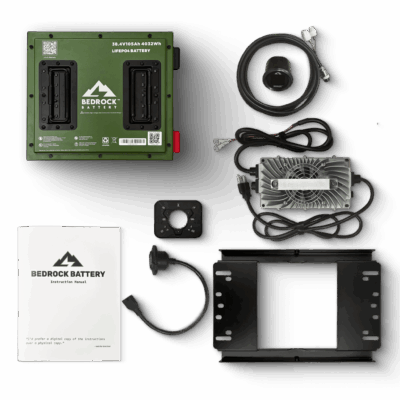
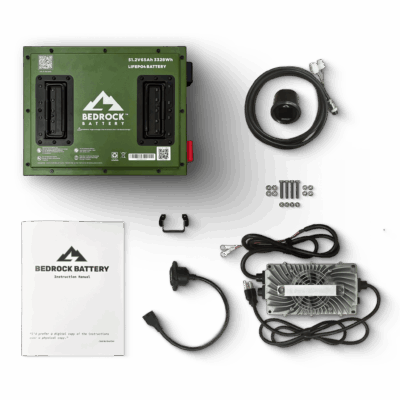
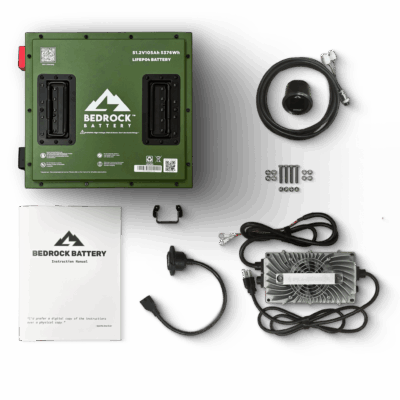
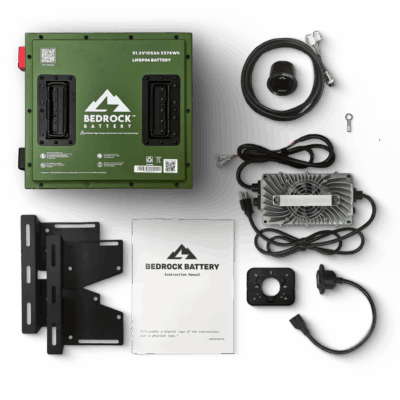
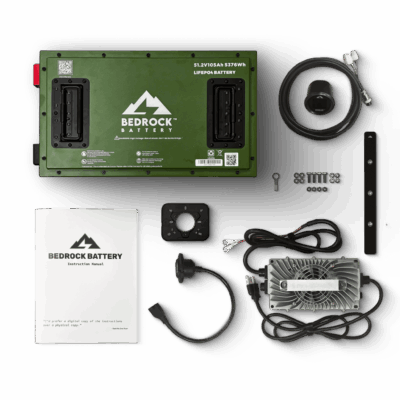
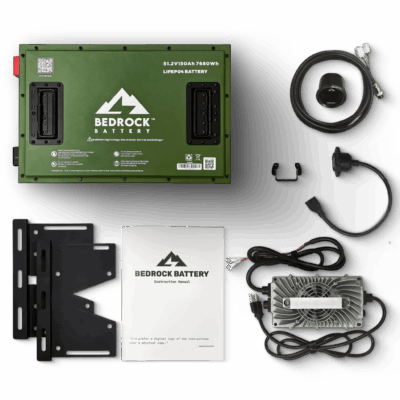
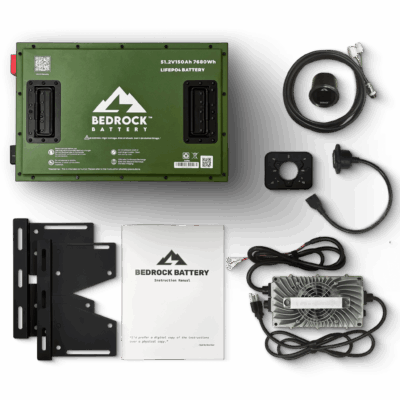
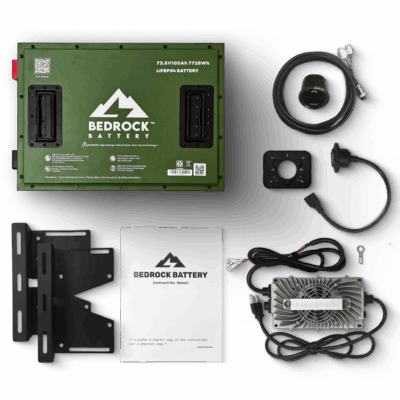
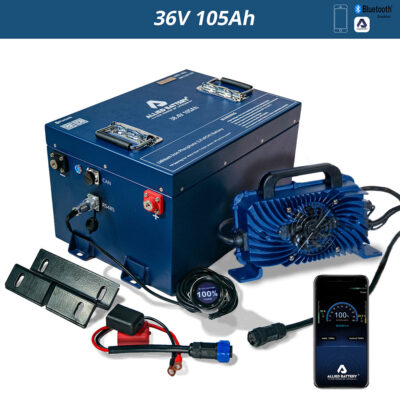
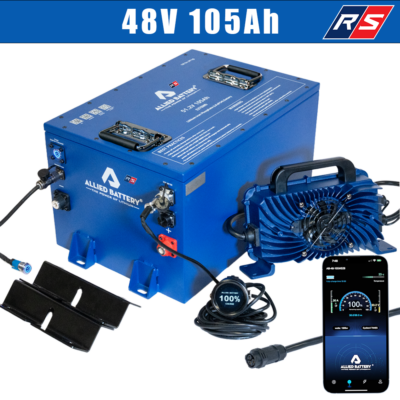
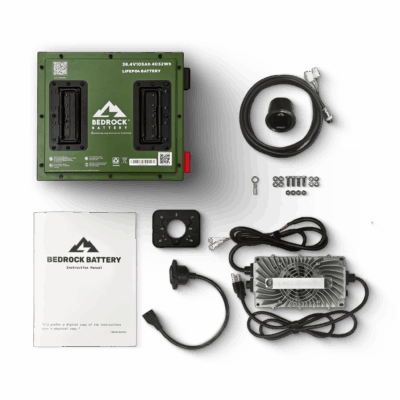
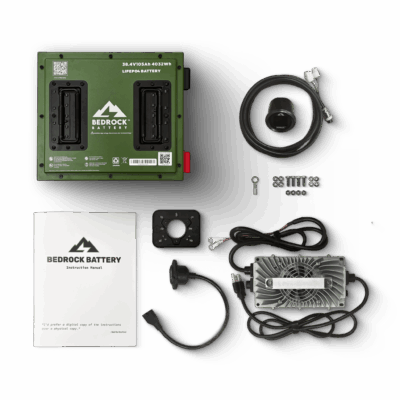
Voltage has to match the cart. Amp-hours are how much work the pack can do at that voltage. A 48-volt 65Ah battery and a 48-volt 105Ah battery are the same voltage and different amounts of stored energy. The two Bedrock 48-volt 105Ah shapes, compact and slim, hold the same 5.38 kWh and fit different trays. A 150Ah 48-volt pack is more energy again. A 72-volt pack is a different voltage, not a ‘bigger 48.’
We will not invent a mile number for a 105Ah pack. Seats, hills, tire size, speed, and a stereo all change distance. Use the manufacturer’s range note on the product page when they publish one, and use your real day of driving as the test. A cart that only does nine holes does not need the same pack as a cart that is a daily driver on a path system.
A lift kit does not change voltage
Bigger tires and a lift pull more amps. They make a marginal pack feel worse on hills and at speed. They do not turn a 48-volt cart into a 72-volt cart, and they do not turn a 36-volt cart into a 48-volt cart. If you want more torque, you are in controller and voltage territory that has to be designed, not guessed in a battery article.
Buy the pack voltage the cart has now, in an amp-hour size that can feed the extra work, and keep the cables tight. Tell us about the lift and the tire size when you ask for a fit, because it explains a complaint. It does not change the bracket.
Series and parallel are different words
The batteries already in a 36-volt or 48-volt lead cart are in series. Voltage adds. Amp-hours do not. Allied Drop-in-Ready 48-volt modules are the exception we sell on purpose: they are designed to be paralleled, voltage stays 48, and capacity adds, and they require Allied’s 500-amp disconnect. Do not parallel random 48-volt lithium batteries from two brands because a forum said capacity adds.
Do not series two 48-volt lithium packs to ‘make 96 volts’ for a cart. That is a different vehicle than the one you have, and it is a good way to destroy a controller. Stay with the voltage the cart was built for unless a named kit and a controller plan say otherwise.
Lights, stereos, and other 12-volt loads
Headlights, a stereo, a fan, a USB port, and a windshield wiper are 12-volt loads. On a lead pack they were often taken from two batteries in the string, which is hard on those two batteries. On a lithium pack they come from the converter. A converter that is missing or undersized shows up as dim lights or a cart that runs with no accessories.
Those loads also spend amp-hours. A cart used at night for neighborhood errands is a different energy job than nine holes at noon. We still will not invent a mile claim. We will say: size the pack for the day you actually drive, and put the converter on the order if the kit does not list one.
AGM and flooded are both lead-acid
AGM costs more up front and does not get watered. Flooded costs less and lasts when someone actually waters it. Both are lead-acid. Both want a full charge after you drive. Both take a lead-acid charger, not a lithium charger. Both carry the $18 core on every battery.
An AGM battery that you decide to ‘maintain’ with a watering jug is ruined. A flooded battery that never gets water is also ruined. Pick the one the household will actually live with. Neither choice is a lithium conversion, and neither one removes the need to match voltage and terminal style.
Parts and pages that match this
- Fitment guide
- Shop
- Lead-acid vs lithium
- Shipping
- Returns
- Warranty
- Contact
- Chargers
- Parts
- 48V/72V converter
- Fitment guide
- Contact
- Shipping
The price for using a serial number for the year is the price on the product page, not a number in this article. Bedrock conversion kits ship free. Allied Lithium packages ship free from Allied. That is not a promise that every brand ships free. We ship using a serial number for the year. We do not list a storefront address. Local delivery is only the area named on the shipping page. A city page on this site is not a statement that a driver covers that city.