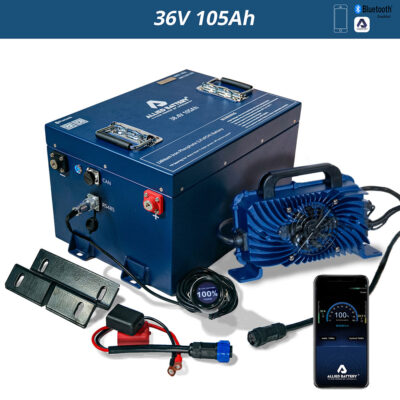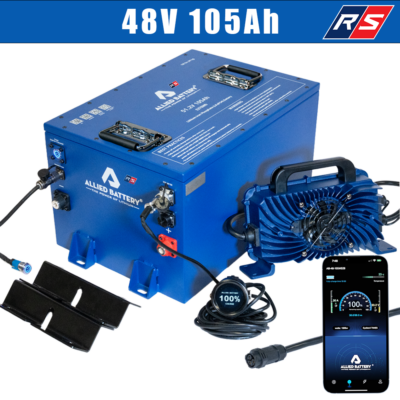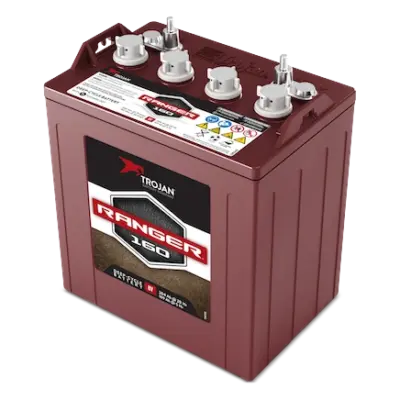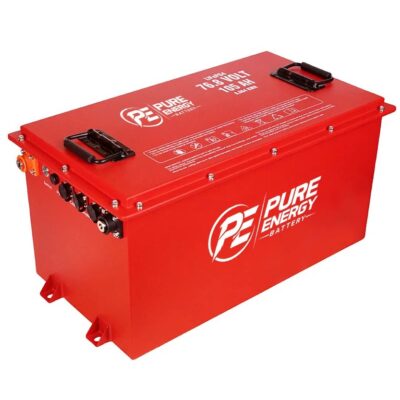

















A cart that sits six months is a storage problem first and a size problem second. A huge pack left discharged still sulfates if it is lead-acid.
The answer for a cart at a second home
Lithium storage follows that battery’s manual, which is not ‘leave it empty.’
Buy the size for the weeks you are there. Do not buy range you will not charge correctly while you are gone.
Count the batteries or read the lithium label before you compare amp-hours. Six 6-volt batteries are 36 volts. Six 8-volt or eight 6-volt or four 12-volt deep-cycle batteries are 48 volts.
Hold that answer while you read the shop notes under it. The notes are the same rules we use on every cart. The answer above is the part that is specific to a cart at a second home.
The 12-volt converter is a separate part
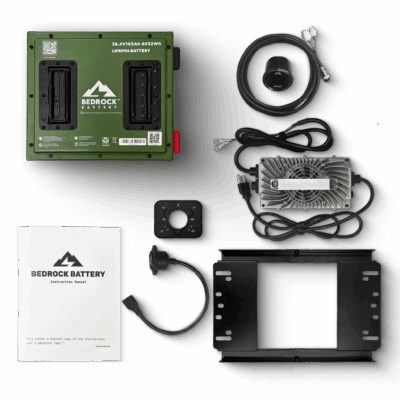
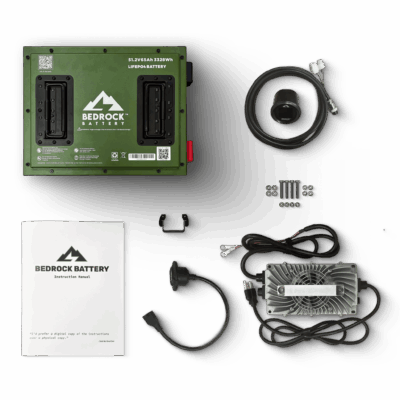
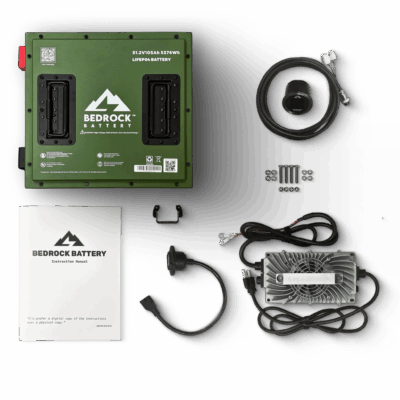
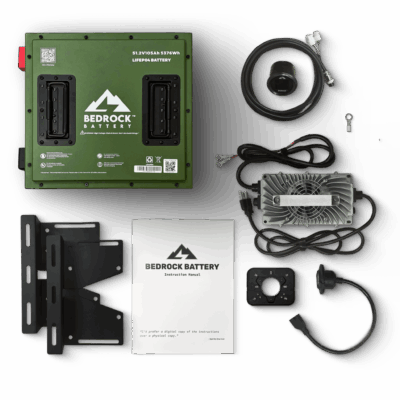
A lead-acid pack often fed 12-volt lights and accessories from part of the string. A single lithium battery does not have that tap. Most carts need a 12-volt converter after the swap, or the lights, horn, and controller accessories fail. Bedrock kits do not include the converter. Bedrock lists one as required for most carts.
A 36-volt lithium cart uses converter SKU BB-CVT-0936. A 48-volt or 72-volt lithium cart uses SKU BB-CVT-0948. Do not add a converter to an order that is already the converter. Do not skip the converter on a 48-volt kit because the cart ‘seems to run’ on a test drive around the block. The motor can run while the 12-volt system is unpowered or, worse, fed the wrong voltage.
BOLT’s voltages are nominal lithium voltages
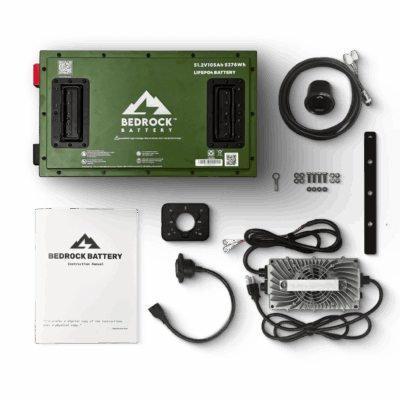
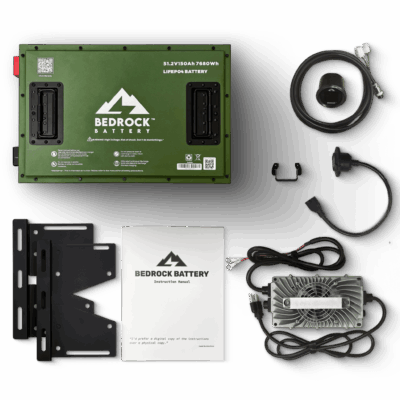
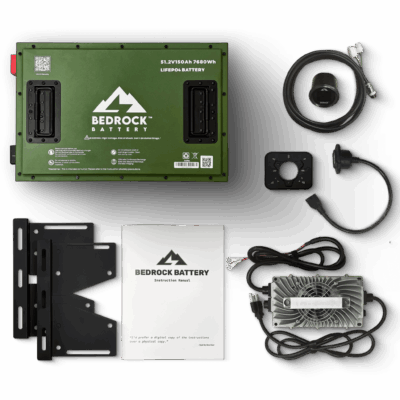
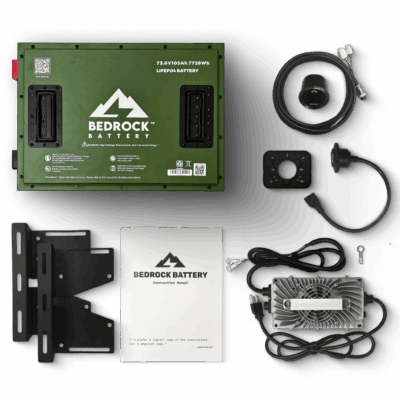
BOLT lists 38.4 volts for 36-volt carts, 51.2 volts for 48-volt carts, and 73.6 volts for 72-volt carts. A 38.4-volt battery is not a weak 48-volt battery. Capacities in the line run from 60Ah to 160Ah, including a compact 51.2-volt 105Ah Mini. BOLT’s warranty is 12 years and transferable.
Kits name specific carts, including Denago on some listings. If your cart is not named, do not borrow a Club Car bracket and hope. BOLT is based in Largo, Florida, in the Nivel family. That fact does not create a storefront for us in Largo.
Shipping, and what a city page means
We ship golf cart batteries. We ship across the lower 48. Lithium kits ship for a flat rate per order to the lower 48 (flat-rate kit shipping, flat-rate kit shipping, flat-rate kit shipping, flat-rate kit shipping); lead-acid batteries ship by truck freight on a freight quote: we call you with the price before we charge any shipping. Parts, chargers and small batteries ship for a flat-rate per order. Lithium RHINO marine battery kits ship at the $97 RHINO kit rate. Lead-acid batteries and sets ship by truck freight on a freight quote: we call you with the price before we charge any shipping.
A state page or a town page means that community is one we write about and ship to.
Salt air and corrosion
Coastal carts, island carts, and carts parked near a bay grow corrosion on posts and lugs. White or green crust raises resistance. The cart feels weak. The charger works harder. Disconnect the main negative first, neutralize the crust with a baking-soda paste, brush the post and the lug, dry everything, and reassemble the lug flat and tight. A thin film of dielectric grease after it is tight slows the next round.
Salt is not a reason to leave caps off a flooded battery. It is a reason to keep the tops of the cases clean so a film of moisture and acid does not leak current between posts. If the copper strands under the insulation are green, replace the cable. A new battery on a rotten cable will not fix the cart.
S, UT, and UTL terminals
Lead-acid golf batteries are sold with more than one post. An S post, a UT post, and a UTL post do not accept the same lug the same way. Look at the cable end you already have before you pick the dropdown on the product page. Interstate listings in this shop let you choose the terminal on most models.
Bending a lug to reach the wrong post guarantees a loose connection. If the cables are burned, replace the cables and then match the new lugs to the new posts. Do not pick a terminal style because it is the first option in the list.
Partial charges: lithium yes, lead-acid no
Lithium iron phosphate is fine with a partial charge. Plug it in when you get home, unplug it when you leave, and do not wait for a once-a-week deep cycle. Lead-acid wants to be returned to a full charge after you drive. Leaving a flooded pack at half charge is how sulfate hardens.
That difference is why the charger has to match. A lead-acid charger’s finish voltage and equalize behavior are wrong for lithium. A lithium charger’s finish is wrong to interpret with a lead-acid hydrometer. Pick the chemistry, then the habit. Do not teach a household one rule for both.
A load test the household can actually do
Charge the cart, unplug it, rest it, and write down the pack voltage. Then have a helper press the pedal with the drive wheels safely off the ground, or drive up the usual hill while you watch a meter that is connected safely and out of the moving parts. A lead pack that falls apart under that load, while it looked fine at rest, is tired. A pack that holds voltage and still does not move is not a battery problem.
Do not do this with the meter leads in your hand while you drive. Clamp the meter where you can see it, or have the helper only on the pedal with the cart on stands. If you are not comfortable around the posts, stop and send photos. A short across a 48-volt string is a serious burn.
Controllers and batteries are separate decisions
A stock controller expects the pack voltage the cart was built with. A lithium pack of that same voltage is a battery change, not a controller change, on the ordinary conversion kits we sell. A high-amp controller, a lifted cart with a speed project, or a 72-volt build can outgrow the stock solenoid. That is the Curtis Albright conversation.
Do not buy a controller because a battery article mentioned one. If the cart is stock and the complaint is range or watering, the battery and the charger are the job. If the cart was already modified, tell us what the controller label says before we recommend a pack.
Parts and pages that match this
- Fitment guide
- Shop
- Lead-acid vs lithium
- Shipping
- Returns
- Warranty
- Contact
- Chargers
- Parts
- 48V/72V converter
- 48V lithium
- 72V lithium
- Bedrock
- Fitment guide
The price for a cart at a second home is the price on the product page, not a number in this article. Lithium kits ship for a flat rate per order to the lower 48 (flat-rate kit shipping, flat-rate kit shipping, flat-rate kit shipping, flat-rate kit shipping); lead-acid batteries ship by truck freight on a freight quote: we call you with the price before we charge any shipping. Parts, chargers and small batteries ship for a flat-rate per order. Lithium RHINO marine battery kits ship at the $97 RHINO kit rate. Lead-acid batteries and sets ship by truck freight on a freight quote: we call you with the price before we charge any shipping. We ship a cart at a second home. We do not list a storefront address.

Florida installs from Gainesville to Naples: $99 installation on qualifying lithium conversions. Add installation to any 105Ah+ ECO Battery, EPOCH or Lithium Rhino conversion kit and the $99 price (regularly $349) is applied in your cart and at checkout. Offer details
Limited time. Applies to the installation add-on for 105Ah+ ECO Battery, EPOCH and Lithium Rhino lithium conversion kits when the install and shipping ZIP codes are between Gainesville and Naples, FL. Tick "Add professional installation" on the product page; the $99 price shows in your cart and at checkout. Smaller kits and other brands: $349. One install per kit; not combinable with other install discounts.