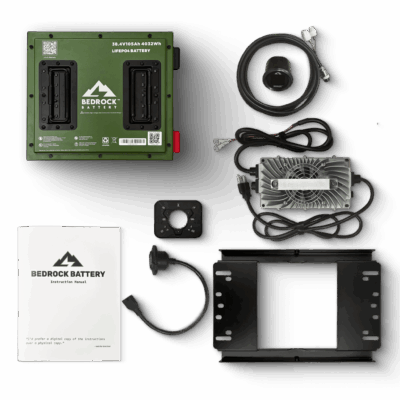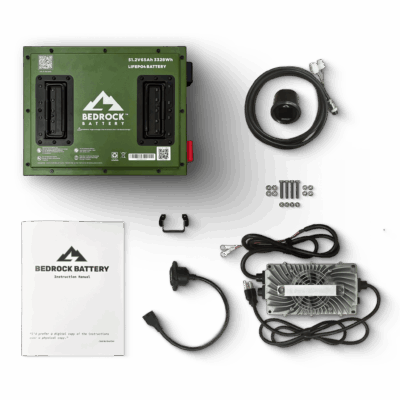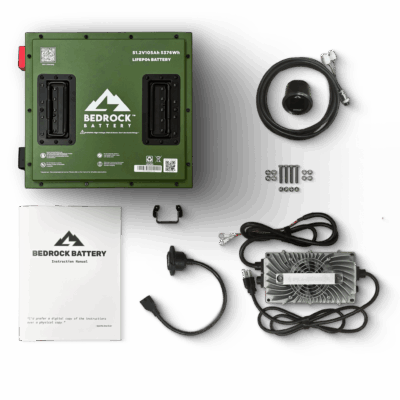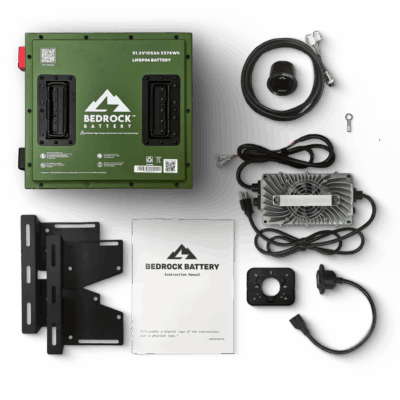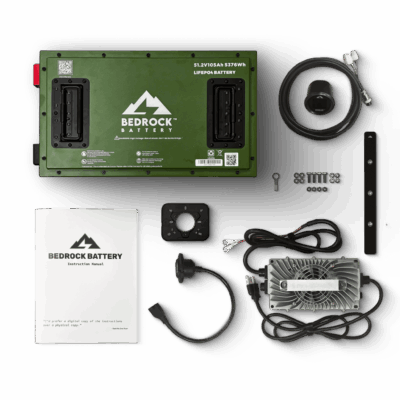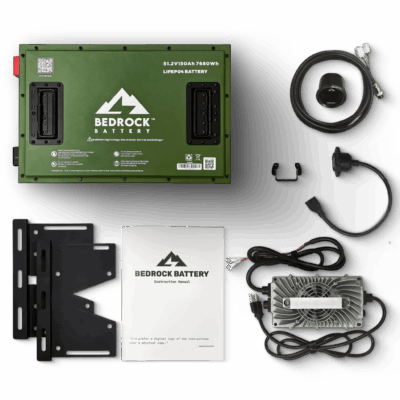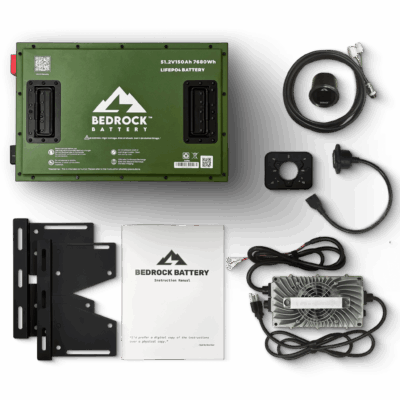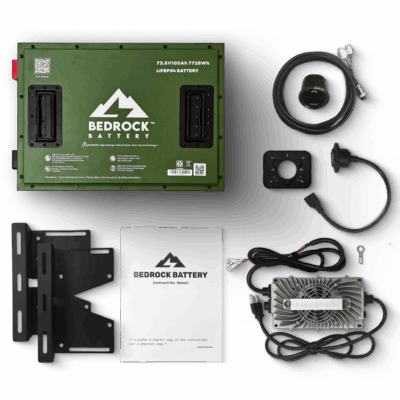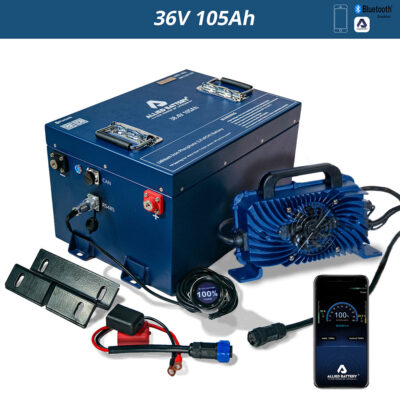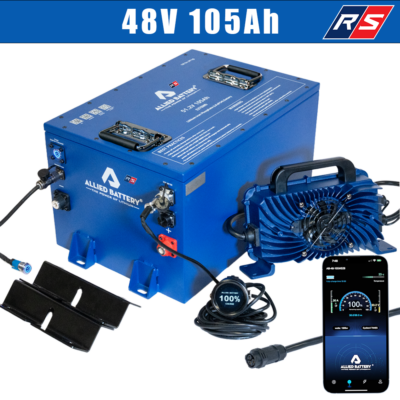


Short, slow trips and a long sit between events. Storage charge and a clean charge port matter more than a 150Ah case.
The answer for a winery or venue cart
Guests will switch accessories on. The converter has to be there.
If the venue has more than one cart, label the voltages. A pretty cart and a utility cart are often not the same pack.
The use changes amp-hours, charging habits, and corrosion. It does not change how series voltage works, and it does not assign a local driver to that use.
Hold that answer while you read the shop notes under it. The notes are the same rules we use on every cart. The answer above is the part that is specific to a winery or venue cart.
Warranties are not all 10 years
Read the warranty that belongs to the brand in the cart. Bedrock kits are 10 years transferable. BOLT is 12 years transferable. ECO listings we carry state a limited lifetime warranty. Allied listings we have seen state 5 or 8 years depending on the line. EPOCH golf listings we carry state 11 years. Dakota deep-cycle listings are mostly 11 years, with shorter terms on chargers. Vatrer listings we carry state 10 years. Lithium Rhino kits are 8 years. BigBattery lists 12 years on the Husky 2. Trojan Lithium lists 10 years. Interstate’s LIGC48V100 is 60 months of a 10-year limited warranty. Antigravity starting batteries we carry state 3 years.
A longer warranty is not a fitment. The bracket still has to match the tray. Register the warranty the way that brand asks. We will not stretch one brand’s term onto another brand in an email.
Charging lithium in the cold
Lithium iron phosphate batteries should not be charged below freezing unless the pack is a heated model and the heater has the pack above freezing. Bedrock offers heated versions. Ask about lead time. Do not assume the kit on the page is the heated one.
A lead-acid battery can be charged in colder weather, and a discharged lead-acid battery can freeze and crack. Store a lead pack fully charged if the cart will sit in a freeze. Store a lithium pack at a partial state of charge if the manufacturer says so, and bring it inside the heated space before you charge it. A garage that is below freezing overnight is a real condition in the mountains and on the Cumberland plateau. It is not a reason to pour hot water on a battery.
Solenoids, clicks, and Curtis Albright
A click when you press the pedal means something tried to close the main contactor. It does not, by itself, mean the pack is done. If pack voltage holds under that load and the cart does not move, look at the solenoid, the key switch, the direction switch, and the safety switches. A solenoid that is welded shut can make the cart creep with the key on. A solenoid that clicks and drops out will not carry motor current.
Curtis Albright heavy-duty contactors are the upgrade when a high-amp controller and a lithium pack pull more current than the original solenoid was built for. A solenoid is a part. It does not add amp-hours. Do not buy one to cure a battery that sags from 50 volts to the 30s under load. That cart needs a pack, or a cable, not a bigger relay.
Equalizing is a flooded-battery procedure
An equalization charge is a controlled overcharge used on flooded lead-acid batteries to knock sulfate off the plates and even the cells out. You do it after the pack is full, with the caps in place, in a ventilated area, and you water after, not before. You do not equalize AGM batteries. You do not equalize a lithium pack. A lithium BMS is not asking for an equalize cycle from a lead-acid charger.
If one flooded battery is far below the others every month, equalization will not rebuild a dead cell. Replace the set. If you do not know whether your charger has an equalize mode, do not hold the button and hope. Read the charger manual for that one pack voltage.
Universal kits are a specific product
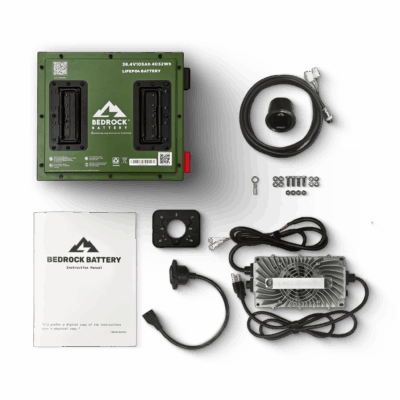
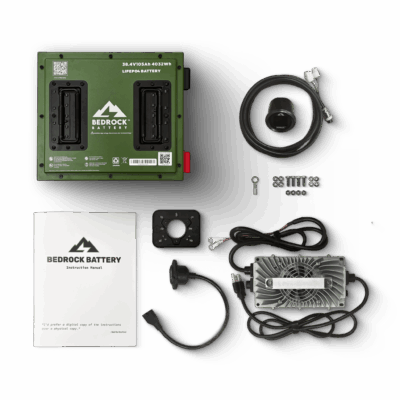
A universal lithium kit is the kit for a cart that does not have a named bracket in the line, or for a tray someone has already modified. It is not a cheaper version of a Precedent kit. Bedrock’s universal hardware is its own product. On some voltages the manufacturer’s photo of a named cart is the same file as the universal kit, because the hardware in that photo is the hardware they ship for both. Buy the title that matches the fitment guide, not the photo that looks familiar.
If your cart is a Denago, an Evolution, a Star EV, or an Advanced EV, start with a product whose page names that make. Fall back to universal only when the named list does not include your model. Do not fabricate a mount and then call it universal.
Outlets, cords, and tripped breakers
A golf cart charger is a continuous load. A thin extension cord, a coiled cord, or a tired GFCI outlet will heat or trip. Use a cord rated for the charger, keep it uncoiled, and plug into an outlet that can hold the load. A charger that resets every night is not ‘just sensitive.’ It is cooking a connection.
Do not plug a 48-volt charger into a pack of unknown voltage to ‘see what happens.’ Read the pack first. If the outlet is in a flood-prone garage, get the charger up off the floor. Salt air corrodes charge-port pins. A port that has to be wiggled to start the charge needs to be replaced, not lived with.
Resting voltage, not a guess from the seat
A resting check is not a load test, and it is still the first number worth writing down. Charge a lead-acid pack fully, unplug the charger, and wait a few hours. A healthy flooded 6-volt battery rests near 6.3 volts. A healthy 8-volt rests near 8.4. A healthy 12-volt deep-cycle rests near 12.6. Measure the pack from the main positive to the main negative too. A 36-volt string of six 6-volt batteries rests near 38 volts. A 48-volt lead string rests near 50 volts.
A battery that sits a full volt under its neighbors is the weak one. Replace the set anyway. One new battery in a tired string does the work for the old ones. A lithium pack does not use these lead-acid resting numbers. Read the meter that came with the kit, and do not call the pack dead because it is not sitting at 50 volts.
Parts and pages that match this
- Fitment guide
- Shop
- Lead-acid vs lithium
- Shipping
- Returns
- Warranty
- Contact
- Chargers
- Parts
- 48V/72V converter
- 48V lithium
- Bedrock
- Fitment guide
The price for a winery or venue cart is the price on the product page, not a number in this article. Bedrock conversion kits ship free. Allied Lithium packages ship free from Allied. That is not a promise that every brand ships free. We ship a winery or venue cart. We do not list a storefront address. Local delivery is only the area named on the shipping page. A city page on this site is not a statement that a driver covers that city.